
If you run a business alone and plan week to week, the same deadlines can catch you off guard every year. You need a yearly business calendar.
Build it in a set order: the dates that cannot move go down first, and everything else fits around them. Your first yearly business calendar will probably look messy, and that is fine.
What it has to be is honest about how many working hours you actually have.
Table of Contents
Start with the dates someone else set
Goals feel like the natural place to start to make your yearly business calendar. But every plan you make for the year has to bend around deadlines you do not control, so those go on the page first.
For a solo owner, that list usually includes tax deadlines, insurance renewals, professional license renewals, software subscriptions, and domain renewals. If you run your business as an LLC, it also includes any recurring filings your state requires.
That one is easy to lose track of. You do it once a year, so it never turns into a habit (and nothing about a normal Tuesday reminds you it exists).
Different State Filings
Those filings don’t follow one national schedule. Florida wants an LLC’s annual report between January 1 and May 1 every year, according to the Florida Division of Corporations. California runs on a two-year cycle instead: its Statement of Information is due within 90 days of forming and every two years after that, according to the California Secretary of State.
LLCBuddy, the LLC research site run by business formation expert Steve Goldstein, lays out annual report deadlines by state, but the exact date and fee for your own business still come from your state’s official website.
Florida wants May 1, Delaware wants June 1
Where your LLC is registered decides both the schedule and the penalty for missing it. Compare the three states below, and the spread is obvious.
As of 2026, Florida’s Division of Corporations says LLC annual reports are due by May 1 each year. The filing fee is $138.75. Miss May 1 and a $400 late fee goes on top. The Division is blunt about it: there is no provision to waive or reduce that fee, even if the business never got its filing notice.
Delaware works differently. As of 2026, Delaware LLCs do not file an annual report. Instead, the Delaware Division of Corporations lists a $400 annual tax for LLCs, due on or before June 1. Pay late, and there is a $200 penalty, plus interest of 1.5% per month on both the tax and the penalty. Every Delaware LLC also names a registered agent with an office in the state when it forms. If you pay a service for that, compare Delaware registered agents and put the renewal date on this calendar too.
California and Florida Cycles
California is on a two-year cycle. As of 2026, the California Secretary of State requires LLCs to file a Statement of Information within 90 days of registration and every 2 years thereafter. The fee is $20.
So a Florida owner and a Delaware owner are a month apart on the deadline and pay different penalties for missing it: $400 flat in Florida, $200 plus monthly interest in Delaware. A California owner might not file at all in a given year.
Whatever your state requires, add it to the calendar with the actual date. Then add a second entry about a month earlier that just says “prepare the state filing.” That earlier entry does most of the work.
Your LLC may also owe separate federal and state tax filings. Those go on the calendar too, and a tax professional can tell you which ones apply to you.
Pick three goals and give each one a finish line for Your Yearly Business Calendar
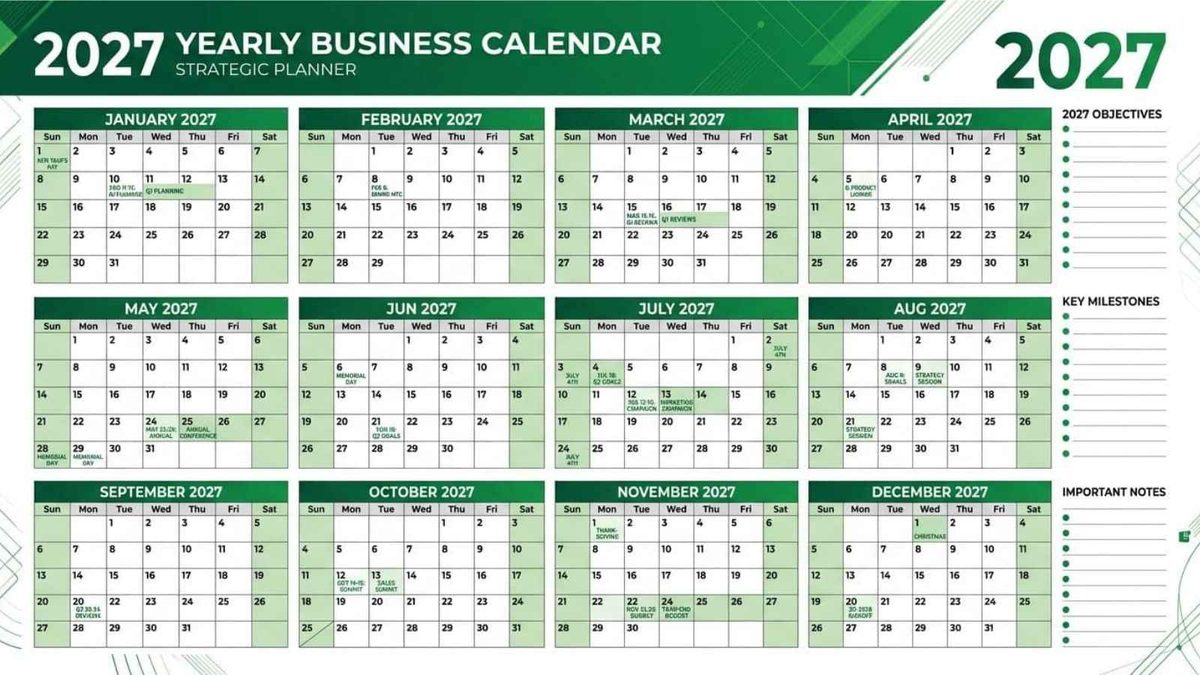
Make Your Yearly Business Calendar Flexible
It’s easy to write annual goals in January as if every month had the same number of working hours. No month does, and a solo owner’s April (with a tax deadline and client work landing in the same weeks) looks nothing like their August.
Three goals is plenty for one person, even though seven feels more ambitious in January. Each goal needs a finish line you can check, such as a revenue target or a product that exists by a certain date. “Grow the business” has no finish line, so there is nowhere to put it on a calendar.
Then split each goal into quarterly checkpoints and put those checkpoints in months where you actually have room. This is the reason the fixed dates go down first.
👉 If your filings and tax deadlines both fall in spring, an April milestone will slip.
Give every launch a decision date
Every launch or campaign you plan this year gets more than one date. Count backward from the live date and mark the day the work has to be finished, the day promotion starts, the day you decide whether it is happening at all, and the live date itself.
The decision date is the easiest to skip, and it saves you the most stress because it gives you a set point to cancel or delay before you sink another month into something that is not working.
Two launches in one quarter are usually too many for someone who is also doing all the client work. Space them out, and if you have to choose, pick the one that pays.
Shade in the slow season before it arrives in Your Yearly Business Calendar
A slow month can go to discounts and extra outreach, or to the work you never have time for, like rebuilding the website or reworking your pricing. Give it to the second. Slow months are the cheapest hours you get all year, and the work you do then pays off once the busy months return.
Pull last year’s income and inquiries and look at them month by month. Wherever they dipped, shade those weeks and assign one project to that window. Just one.
👉 In your first year, there is no data yet. Make an educated guess and correct it next year.
Book time off before clients book it for you
If you wait to take time off until everything is caught up, you will never take it.
- Put your time off on the yearly business calendar before the year fills up, and treat it like a client commitment that only a real emergency can move.
- Check it against your fixed dates too. A vacation in the same week as your state filing or a tax deadline is an easy collision to miss when you plan a month at a time, and a very obvious one when you can see all twelve.
- A reasonable minimum is one full week away in each half of the year, plus a few long weekends right after your heaviest stretches.
- Rest that is scheduled after a crunch actually happens.
- Rest scheduled for “when things calm down” usually does not.
Keep it on one page and review it every quarter
A printed wall planner works for this, and so does a spreadsheet with a column for each month. The one requirement is that you can see the whole year at once, because a calendar you only ever view a week at a time is really a to-do list with dates on it.
Four categories are enough: fixed obligations, goals and milestones, launches, and time off. Slow seasons can sit underneath as shading.
Then put a 30-minute review on the calendar at the start of each quarter. Look at what slipped and at what the next 90 days hold.
While you are in there, recheck your upcoming filing dates and fees on your state’s official website. States do change them, so last year’s number may not be the same this year.
Most of next year is already knowable
A yearly business calendar catches the surprises that were predictable all along. The state filing deadline was knowable in January. So was the launch that needed six weeks instead of two.
The deadlines were always going to arrive. The only question is whether they reach your calendar before they reach your inbox.
Do you make yourself a yearly business calendar? I’d love to hear about it in the comments below. 👇
I have one for expenses and another for income, along with a yearly business to-do calendar.
FAQS
Do I really need a full yearly calendar if I already plan week to week?
Yes. A yearly view shows the fixed deadlines and slow periods you can’t see when you only look one or two weeks ahead. It keeps those predictable items from becoming last-minute surprises.
Why start with tax and filing dates instead of my goals?
Those dates are set by someone else and can’t move. Once they’re on the calendar, you can place your goals and launches in the months that actually have room.
How many goals should a solo owner put on a yearly calendar?
Three is usually enough. Each one needs a clear finish line (a revenue number, a product launch date, etc.). More than three tends to slip when client work gets busy.
What if this is my first year and I don’t have last year’s numbers?
Make your best guess about slow months and put one project in each of them. You’ll correct the calendar next year once you have real data.
How often should I look at the yearly calendar?
Keep the whole year on one page, then do a short review at the start of each quarter. That’s enough to catch what slipped and adjust the next 90 days.
Disclosure: This Small Biz Tipster blog post may contain affiliate links. I may earn a commission from qualifying purchases at no extra cost to you. Some sections were drafted with AI tools and carefully reviewed/edited by me.

I’m Lisa Sicard, founder of Inspire To Thrive.
Small Biz Tipster is my dedicated space for straightforward, no-nonsense tips that help small business owners grow smarter and faster. Voted in the Top 100 Small Business Blogs by Feedspot for 2025 and 2026, and with over 30 years of hands-on digital marketing experience, I share simple strategies here so you can save time on social media, attract more customers, and focus on what you love — running your business. Through Inspire To Thrive, I also provide social media management, training, and consultations.