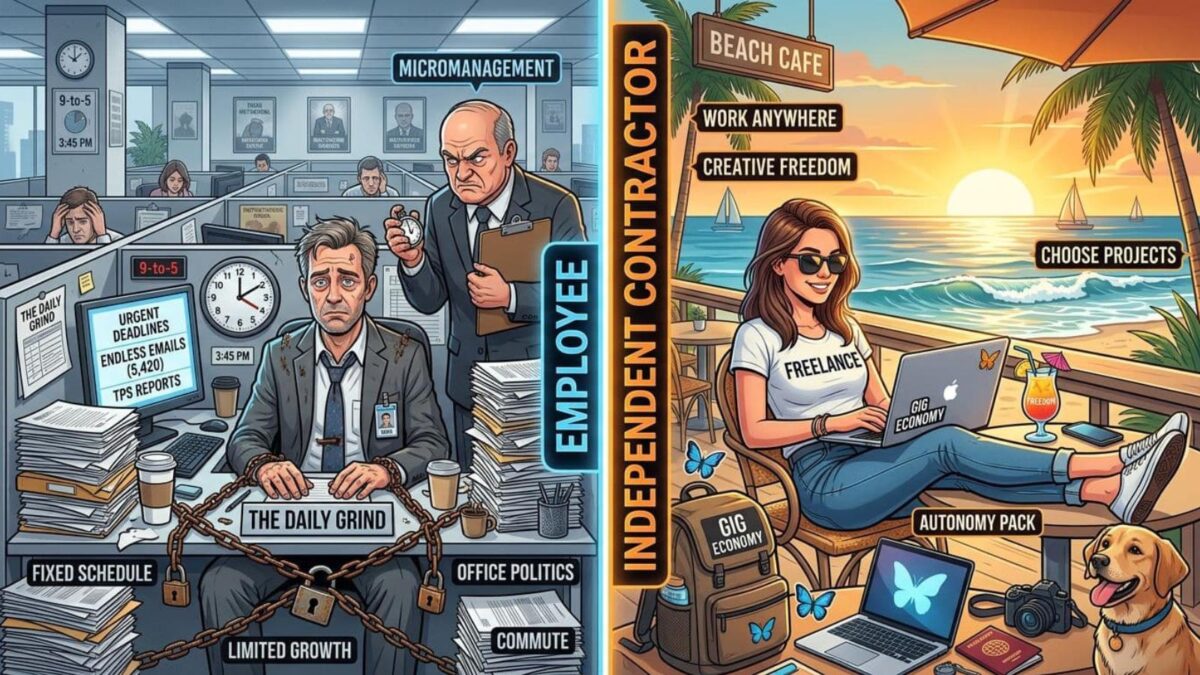
If you hire freelancers, gig workers, or part-time help, Independent Contractor vs. Employee worker classification rules aren’t just legal talk; they affect your payroll and your risk of misclassification. In March 2026, the issue is back in the news because a federal proposal could rescind the 2024 rule.
Public comments closed on April 28, 2026, and a final rule is expected later in 2026; the 2024 rule stays in effect until then. Below in this Small Biz Tipster blog post, you’ll learn what might change, why it matters for your business, and what you can do right now.
Table of Contents
Key Takeaways: Independent Contractors vs Employees
- The U.S. Department of Labor may rescind the 2024 rule in 2026, which could shift federal guidance toward a more employer-friendly standard.
- Public comments close April 28, 2026, and a final rule may follow later in 2026.
- Classification affects real costs, because employees trigger payroll taxes, withholding, overtime rules, and W-2 recordkeeping.
- Using contractors can cut administrative work, but the risk of misclassification rises when the day-to-day work resembles employment.
- Strong contractor signals include business independence, such as serving other clients, using their own tools, quoting by project, and taking on profit or loss.
- Reduce risk now by matching paperwork to reality, updating contracts, avoiding employee-like perks, keeping invoices and proof of business status, and using Form SS-8 when status stays unclear.
What the 2026 proposal would do, and why you should care
The U.S. Department of Labor has proposed rescinding the 2024 independent contractor rule. In plain terms, this could move federal guidance back toward a more employer-friendly standard for classifying workers under wage-and-hour law.
That matters because the independent contractor vs. employee classification ties to real costs. An employee often triggers employment tax obligations, such as:
- Social Security and Medicare taxes.
- Unemployment taxes.
- Withholding requirements for income taxes.
- Overtime rules.
- Recordkeeping duties, such as issuing Form W-2.
A contractor setup can reduce admin, but it increases the risk of misclassification if the day-to-day relationship looks like employment.
If you get it wrong, you can face audits, wage claims, and back payments. This is a proposal during a comment period, not the final rule yet, but it’s a good time to tighten your practices.
The timeline you need to track right now
Mark April 28, 2026, as the deadline to submit public comments. After that, watch for a final rule later in 2026. Also, keep an eye on your state labor agency, because state classification tests under the Labor Code can be stricter than federal guidance.
Independent Contractor vs. Employee: the real-world factors that often decide it
In day-to-day life, classification often comes down to a simple idea: the right to control how independent the worker is, and how much control you keep. Think of it as borrowing a tool rather than hiring a teammate.
If the person plugs into your routines and rules, they can look like an employee. Under common law, this right to control has long been the primary factor in distinguishing between independent contractors and employees, with courts applying standards such as the ABC test or the Borello test.
For example, a freelance social media manager who brings their own plan, tools, and client list may fit the contractor status. On the other hand, a “contractor” delivery driver who must follow your route, wear your gear, and work set shifts can raise red flags.

A bookkeeper who serves multiple businesses looks different than one who works only for you, every weekday. A handyman quoting a job by project also sends a different signal than someone paid hourly to handle whatever comes up.
Just as important, your label doesn’t decide it. A 1099 form doesn’t override the reality.
Control, schedule, and training, where businesses trip up
The degree of control over the type of relationship is where the hiring entity often trips up. If you set a work schedule, require step-by-step methods, or supervise closely through behavioral control, you add employee-like control.
Requiring permission for time off can also point that way. In contrast, a contractor usually sets their own schedule, chooses their process, and may send a substitute if the agreement allows.
Profit, loss, and business independence are what contractors usually show
Contractors often invest in their own tools and supplies, market to other clients, and may carry insurance under their own financial control. They can quote by project, face profit or loss, and earn more by working efficiently.
Long-term, exclusive work can still look like employment, even when the person is great.

Simple steps you can take now to lower risk while the rule is in flux
You don’t need a lawyer on speed dial to start reducing risk. You do need your paperwork and your day-to-day habits to match. If a role feels “sort of like staff,” treat that as a signal to review it.
For higher-risk roles, when in doubt about status, consider filing Form SS-8 for an IRS determination; a qualified HR pro or employment attorney can help you spot gaps fast.
A quick contractor checkup, you can finish this week
Use this quick check to bring your practices in line:
- Control: Confirm who sets hours and how the work gets done.
- Other clients: Ask whether the worker is self-employed and actively serves other customers.
- Agreement: Update written contracts with scope, deliverables, deadlines, and payment terms for nonemployee compensation.
- Pricing: Move toward project-based fees (not payment of wages) when it fits the work.
- Perks: Avoid employee benefits, paid time off, or approval chains from managers.
- Records: Keep invoices, business registration, insurance proof (if relevant), and documentation of business expenses; issue Form 1099 to your 1099 contractors.
Misclassification carries high stakes, including liability for unpaid Social Security and Medicare taxes.
Conclusion
The independent contractor vs. employee line may shift again if the 2024 rule is rescinded later in 2026. Follow federal and state updates, and submit a comment if the change hits your industry hard.
Most of all, clean up your worker classification now, while you still control the pace. Pick your top two contractor roles and run the checkup this week.

I’m Lisa Sicard, founder of Inspire To Thrive.
Small Biz Tipster is my dedicated space for straightforward, no-nonsense tips that help small business owners grow smarter and faster. Voted in the Top 100 Small Business Blogs by Feedspot for 2025 and 2026, and with over 30 years of hands-on digital marketing experience, I share simple strategies here so you can save time on social media, attract more customers, and focus on what you love — running your business. Through Inspire To Thrive, I also provide social media management, training, and consultations.