You may be looking to make your small business more professional so it can compete with larger players in your niche. Of course, if you have high-speed fiber optic internet rather than cable service, your productivity increases.
Here are some tips for playing the “corporate” game at their own game by using fiber optic internet for your small business.
Table of Contents
Key Takeaways of Internet Services
- Fiber-optic internet transmits data as light through glass or plastic fibers, which helps deliver higher speeds and more bandwidth than cable (copper) internet in many areas.
- For small businesses, fiber provides faster upload speeds, lower latency, and steadier performance for tasks like video calls, cloud backups, and website updates.
- Fiber lines resist electromagnetic interference, which can improve reliability compared to copper-based connections.
- Fiber is hard to tap without detection, but real security still depends on strong encryption, authentication, and good cybersecurity habits.
- If your team depends on cloud apps and frequent file sharing, fiber usually provides a smoother day-to-day workflow than cable.
What is Fiber Optics?
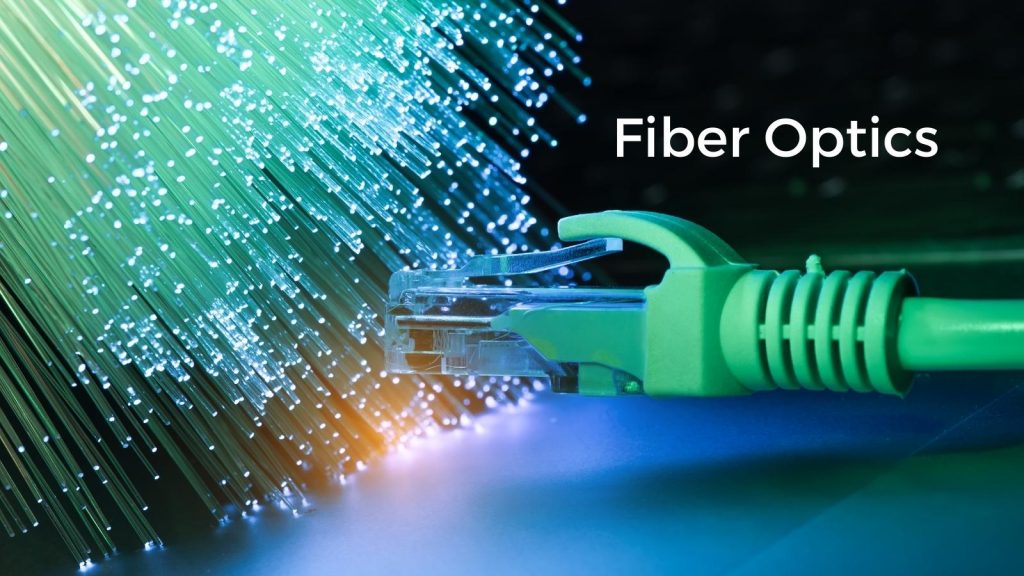
Fiber-optic internet transmits data as light through glass or plastic fibers.
How Does Fiber-Optic Internet Work?
Fiber optic internet uses thin glass or plastic cables to transmit data via light signals. It converts electrical signals into light pulses, which travel through the wires at incredibly high speeds.
Fiber-optic cables have significantly greater bandwidth capacity than traditional copper cables.
They’re also less susceptible to electromagnetic interference. Light signals can travel for miles without degrading, enabling faster internet speeds over long distances.
Fiber internet offers ultra-low latency and insanely fast download/upload speeds compared to DSL or cable.
Secured Communication Channels with Fiber Optic Internet
A key business strategy is clear communication. Communication channels help with everything, from logistics and sourcing to client and customer complaints.
Hence, you should provide as many clear communication channels as possible for your small biz.
These include, but aren’t limited to, business email addresses to relevant departments, PO boxes, and secure telephone lines. Without these basic systems, your operation cannot handle incoming queries and will look unprofessional.
Your Website Makes Your Business More Professional
You can no longer ignore your business website. If you don’t have one, then get one immediately. With builders like Wix, you can have a running website within hours of signing up.
Over 90% of customers will Google a business before using it, so for that reason alone, you need one. Or you miss out on potential business.
But you will also need a relevant domain name, rather than a free-assigned one, to stand out and boost your company’s SEO.
With FIOS internet, you can build and update your website more efficiently every day. You can’t just set it up and forget about it.
Fiber Optic Networks Provide Upgraded Networks and Connections
Nobody wants to work at a company with slow and outdated internet speeds. And doing business with a slow connection is almost impossible these days.
Therefore, you must invest in upgrading your internet infrastructure to make your business and office life easier.
However, the security issue with a slower speed also makes you a more vulnerable target for hackers. Fiber-optic internet for business is the fastest option around, compared to the more convenient wireless options.
See the following infographic for more information about fiber optic internet:
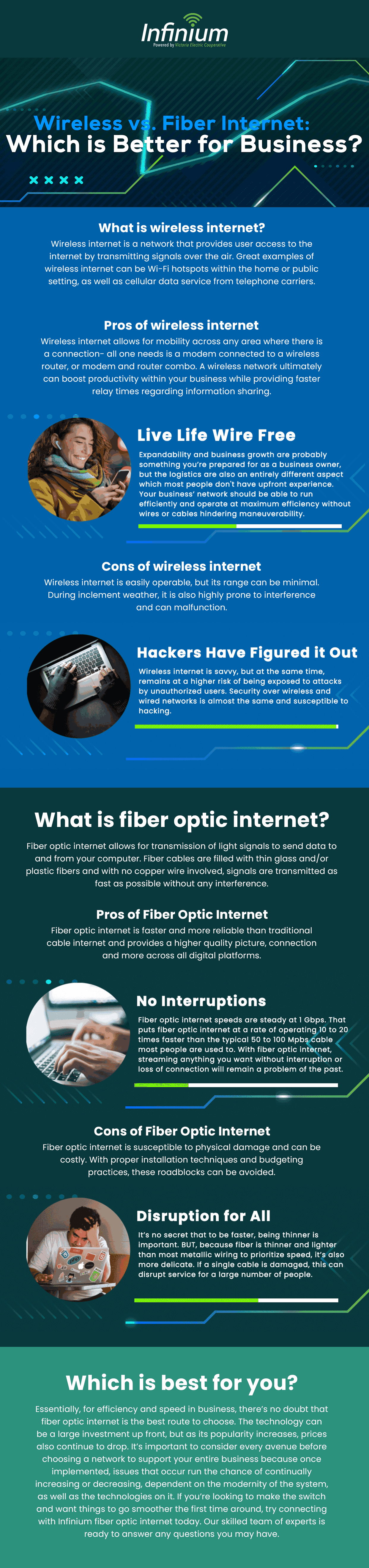
Infographic designed by the pros of fiber internet
Fiber Optic Internet Security
Fiber optic internet is generally considered secure due to its physical properties. Unlike traditional copper cables, fiber-optic lines don’t radiate electromagnetic signals, making it nearly impossible to intercept data via inductive methods.
Additionally, fiber optic cables are difficult to tap without disrupting the connection, making unauthorized access noticeable.
However, security depends on the proper implementation of encryption and authentication protocols by both service providers and users.
While the physical medium offers inherent protection, end-to-end security requires robust cybersecurity measures to safeguard data transmission and works in tandem with your wireless business internet in most use cases.
It’s important to liaise with your server hosting team or outsourced cybersecurity consultants to ensure the best compromise between security, accessibility, and speed.
A How-To-Decision Checklist:
- Required upload speed
- Number of staff devices
- Video call frequency
- Cloud backup needs
- Budget
- Availability in your area
In Conclusion: Fiber Optic Internet vs. Cable for Business
Have you used fiber optics in your area? I had used it for many years before my move to a rural area. It was super fast and reliable compared to cable and other internet service providers.
I’m thrilled that Fidium FIOS arrived in our rural area in the Northeast a few months ago. It has been a huge timesaver. I can work at any time without interruptions. It has been a lifesaver for my small business.
Have you been able to choose fiber optic internet over cable in your area yet?
Frequently Asked Questions About Fiber-Optic Internet vs. Cable for Small Business
What is fiber-optic internet (in simple terms)?
Fiber-optic internet uses thin glass or plastic strands to send data as pulses of light. Because it uses light instead of electricity over copper, it can support higher bandwidth and strong performance over distance.
How does fiber compare to cable internet for business use?
Fiber often delivers faster upload speeds and lower latency than cable, which helps with video meetings, cloud tools, and file sharing. Cable can still work well, but it may slow down more during peak hours depending on local network demand.
Why do upload speed and latency matter for small businesses?
Upload speed affects how fast you send files, sync cloud data, and back up systems. Latency affects real-time tasks like Zoom calls, VoIP phones, and screen sharing, so lower latency usually feels more responsive.
Is fiber-optic internet more secure than cable?
Fiber can be harder to intercept because it does not radiate electromagnetic signals like copper can. Still, you need modern security basics (encryption, strong passwords, multi-factor authentication, and secure devices) to protect your data end-to-end.
What business tasks improve the most after switching to fiber?
Day-to-day work improves most when you rely on cloud apps, large file uploads, video calls, website updates, and shared team systems. In other words, fiber is most effective when your internet connection serves as a core business tool rather than just a utility.