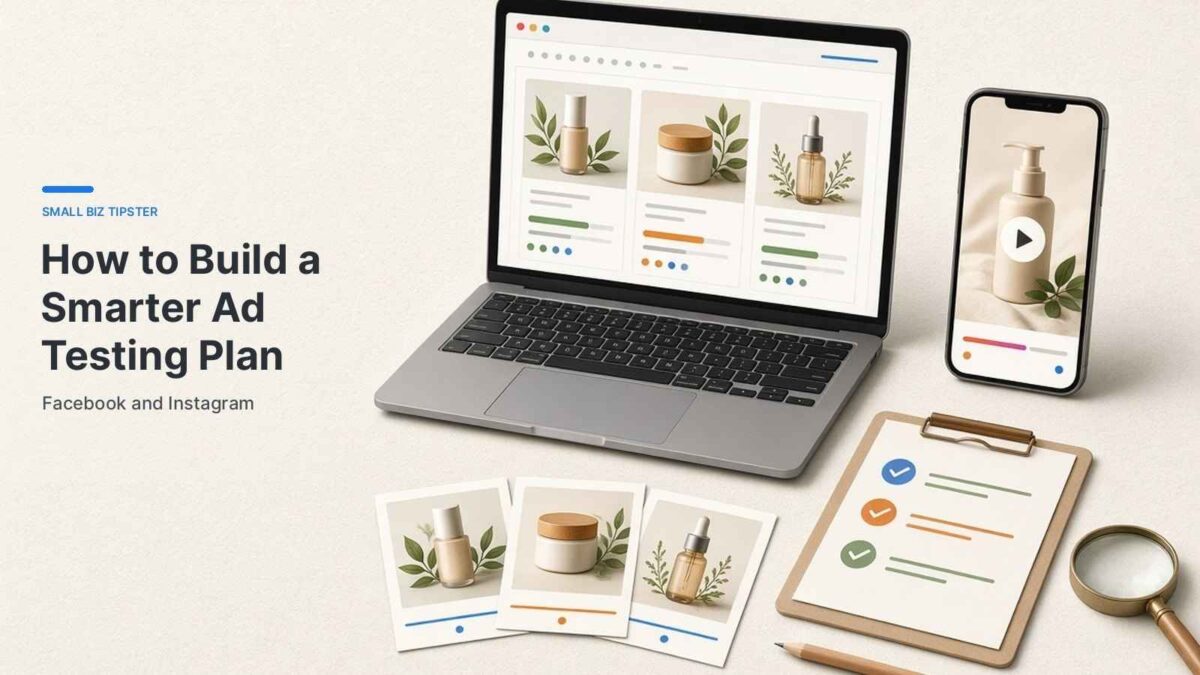
A Facebook ad testing plan works better than making more ads at random. They come from testing clear ideas, measuring the right outcomes, and using each campaign to guide the next.
An AI Facebook ad generator can help a team produce starting variations quickly, but the testing plan determines whether those variations create useful learning.
A smart plan does not require an enormous budget or dozens of nearly identical designs. It requires a focused question, a controlled comparison, reliable tracking, and enough patience to evaluate performance beyond early clicks.
Table of Contents
Key Takeaways
- Begin every test with one specific question and one primary success metric.
- Test meaningful differences in hooks, messages, formats, proof, or calls to action.
- Keep the audience, offer, and landing page consistent when a clean comparison matters.
- Use enough budget and time to gather useful directional evidence.
- Judge ads by business outcomes, not engagement alone.
- Document each result so future campaigns build on proven lessons.
Why Facebook Ad Testing Needs a Clear System
Random creative changes make results difficult to interpret. If one version uses a different video, headline, offer, audience, and destination page, a better outcome does not reveal which change made the difference. A structured process separates a genuinely stronger idea from a lucky short-term result.
This matters even more when delivery systems automatically allocate spend to ads that appear more likely to produce the desired result. Teams need a plan that gives automation useful options while preserving enough control to understand what is working.
Testing a new customer story against a product demonstration is a concept test. Changing a button color or moving a logo is usually creative polishing.
Start With a Specific Test Question
A good test starts with a question that campaign data can answer. For example, ask whether a problem-focused opening will outperform a product-focused opening, whether a short vertical video will bring more qualified visitors than a static image, or whether customer proof will produce more purchases than a feature list.
The question should identify both the change and the desired outcome. “Will a simpler call to action improve completed purchases?” is more useful than “Which ad looks best?” because it provides the team with a clear basis for decision-making.

Most useful tests focus on one main variable at a time. The variable can be the hook, the central message, the format, the proof point, the call to action, or the placement. Keep other important conditions steady whenever possible.
- Hook: The first visual, line, or moment that earns attention.
- Message: The benefit, promise, or problem the ad addresses.
- Format: A static image, carousel, short video, or Reels-style asset.
- Proof: A review, demonstration, result, or creator perspective.
- Call to action: The next step requested from the viewer.
That is the core of Facebook ad testing: change the hook, message, format, proof, or call to action, and leave the audience, offer, and landing page alone.
Build a Small Set of Meaningful Variations
Create a few distinct directions rather than a large batch of minor revisions. Each variation should have a purpose. One ad might demonstrate the product in use, another might tell a customer story, and a third might show a before-and-after situation or address a common mistake.
Visual decisions should reinforce the message. A customer testimonial works best when the connection among the person, outcome, and product is easy to understand. A direct offer should make the terms and next step clear without burying them under decorative elements.
Design for Each Placement
One asset will not always look equally strong in Feed, Stories, and Reels. Use vertical creative for full-screen placements, and prepare square or landscape versions when they better fit Feed delivery. Keep essential text, branding, and product details away from the edges, where cropping or interface elements may obscure them.
Short-form video also needs a clear opening, readable captions, and a message that remains understandable when sound is unavailable. Use Reels testing guidance to review placement considerations, vertical presentation, and creative choices before launching.
Vertical creative also matters for organic posts. See these Instagram marketing ideas for small business before you resize the same asset for Feed, Stories, and Reels.
Set the Budget, Window, and Decision Rules
Set a spending limit and a testing window before launch. The appropriate amount depends on the campaign objective, audience size, and expected cost per result. Very small budgets can provide a directional signal, but they may not support a confident conclusion.
A small Facebook ad testing budget can still teach you something if the question and the cutoff are set before you launch.
Avoid declaring a winner after only a few hours of delivery. Define a minimum threshold in advance, such as a target number of landing page views, leads, purchases, or amount spent.
Also, decide what result would justify pausing, retaining, or retesting an ad.
Pick Metrics That Match the Goal
- Awareness: Reach, frequency, video completion rate, and cost per thousand impressions.
- Traffic: Link click-through rate, landing page views, and cost per visit.
- Leads: Cost per lead, form completion rate, lead quality, and sales follow-up rate.
- Sales: Conversion rate, cost per purchase, revenue, and return on ad spend.
👉 A low-cost click is not automatically valuable. If visitors leave quickly, do not submit a form, or do not buy, the ad may be attracting attention without attracting the right prospects.
Use a Simple Testing Workflow
- Write the test question and choose the primary metric.
- Select one major variable to compare.
- Create a small group of distinct creative versions.
- Keep the audience, offer, and destination consistent where practical.
- Confirm links, pixels, events, and conversion tracking.
- Launch the ads and check for delivery or tracking problems.
- Compare results after the planned threshold is reached.
- Record the decision and use the lesson in the next test.
Read Results Without Jumping to Conclusions
Review the spend distribution before judging the creative. If one ad received far more deliveries than another, the comparison may need more time or a different setup.
When useful, inspect results by placement, device, location, or audience segment, but avoid treating every small difference as a meaningful pattern.
For example, two ads may have similar click-through rates, while one generates substantially more completed purchases. The purchase-focused ad is likely the stronger business choice, even if the other attracts slightly more clicks.
👉 Good Facebook ad testing compares the result you said you cared about, not the metric that looks best on the first day.
Know When to Pause, Scale, or Retest
Pause an ad when
- It has received a fair comparison but remains below the campaign target.
- It drives poor-fit leads, weak landing page engagement, or low-quality traffic.
- Its message appears to create confusion about the offer.
Scale or retest when
- Scale when the ad meets the main goal and performs consistently across useful segments.
- Retest when delivery was too limited, tracking failed, or several major variables changed together.
- Refresh a winner when frequency rises, and click-through rate, conversion rate, or cost per result begins to worsen.
Use Automation Without Losing Judgment
Automation can speed up creative production, organization, and comparison, but it cannot replace human review. Check product claims, visual details, captions, accessibility, brand tone, and calls to action before ads go live.
Recent AI-assisted ad experimentation options can expand the number of ideas a team can explore, but campaign data should still determine which ideas earn more investment.
If you are still deciding whether Ads Manager is worth it, start with this look at Meta small business support and what it does not cover.
Keep a Creative Testing Log
A Facebook ad testing log is what keeps the next campaign from repeating a test you already ran.
Maintain a simple record for every test. Include the date, goal, audience, creative concept, variable tested, budget, primary metric, result, decision, and next idea. This log prevents repeated mistakes and turns individual campaigns into a practical library of audience insights.
FAQ
How many ads should a small business test at once?
Start with two to four meaningful variations, not a large batch of near-duplicates. Each version should change one main thing, such as the hook, message, format, proof, or call to action.
How long should a Facebook ad test run?
Do not call a winner after a few hours. Set a spending limit and a minimum threshold first, such as a target number of landing page views, leads, purchases, or amount spent. Then judge the test only after that threshold is reached.
What is the best metric for Facebook ad testing?
Match the metric to the goal. Use reach and video completion for awareness, landing page views for traffic, cost per lead for leads, and cost per purchase or return on ad spend for sales. A cheap click is not a win if those visitors do not take the next step.
Should the audience stay the same during a test?
Yes, when you want a clean comparison. Keep the audience, offer, and landing page steady, and change one major ad variable. If several things change at once, a better result will not tell you why.
Can AI write the ads for a test?
An AI Facebook ad generator can quickly produce initial variations. It cannot decide the test question, check claims, or pick the winner. Use the output as a draft, then let campaign results decide what earns more budget.
Conclusion
A stronger Facebook ad testing plan is built on clear questions, meaningful variations, reliable measurement, and disciplined follow-through.
In 2026 and beyond, the teams that learn fastest will not simply produce more creativity. They will build better comparisons, protect their budget from guesswork, and use every result to make the next campaign smarter.
Disclosure: This Small Biz Tipster blog post may contain affiliate links. I may earn a commission from qualifying purchases at no extra cost to you. Some sections were drafted with AI tools and carefully reviewed/edited by me.

I’m Lisa Sicard, founder of Inspire To Thrive.
Small Biz Tipster is my dedicated space for straightforward, no-nonsense tips that help small business owners grow smarter and faster. Voted in the Top 100 Small Business Blogs by Feedspot for 2025 and 2026, and with over 30 years of hands-on digital marketing experience, I share simple strategies here so you can save time on social media, attract more customers, and focus on what you love — running your business. Through Inspire To Thrive, I also provide social media management, training, and consultations.