A compliance analyst checking a new counterparty usually has to open three or four tabs: a registry search, a renewal date, maybe a spreadsheet tracking which codes are coming due. A free LEI Lookup tries to put that whole process on one page, and it does it without charging for the parts that normally come with a paid tier.
A Legal Entity Identifier is a 20-character code that identifies a company or fund in financial transactions and regulatory filings, maintained under a framework established by the Global Legal Entity Identifier Foundation.
Every LEI eventually needs renewal, and a lapsed one can stall a trade or bounce a filing back to the filer. That’s the problem this category exists to solve.
Table of Contents
What is LEI Lookup?
LEI Lookup is a Registration Agent, meaning it’s authorized to register and renew LEIs on behalf of entities rather than requiring them to go through GLEIF directly. The site lets anyone search global LEI data and pull up a record page for a specific entity, showing its registration status and associated details.
That search function is the entry point, but the registration and renewal side is where the agent relationship actually gets the work done. You can check any entity worldwide and confirm its code is current before a deal closes, rather than discovering after the fact that a transaction needs to be unwound.
For a compliance or onboarding team, that’s the difference between a five-minute check and a multi-day cleanup.
How the registration and renewal process works
The mechanics are straightforward once you break them into steps:
1. Search for the entity using its name, LEI code, or jurisdiction to pull up its record.
2. Review the record page for current status, registration date, and renewal due date.
3. Register or renew directly through LEI Lookup if the entity needs a new code or an update.
4. Add it to a Watchlist so its status gets tracked going forward instead of being checked manually again.
That last step is the one most lookup tools skip. The Watchlist dashboard tracks the status of every LEI an account is responsible for in one place, so nobody has to log into GLEIF’s public search and check entities one by one.
For a team managing even a dozen counterparties, that single view replaces a recurring manual task with something closer to a dashboard check.
The tools that usually cost extra are included for free
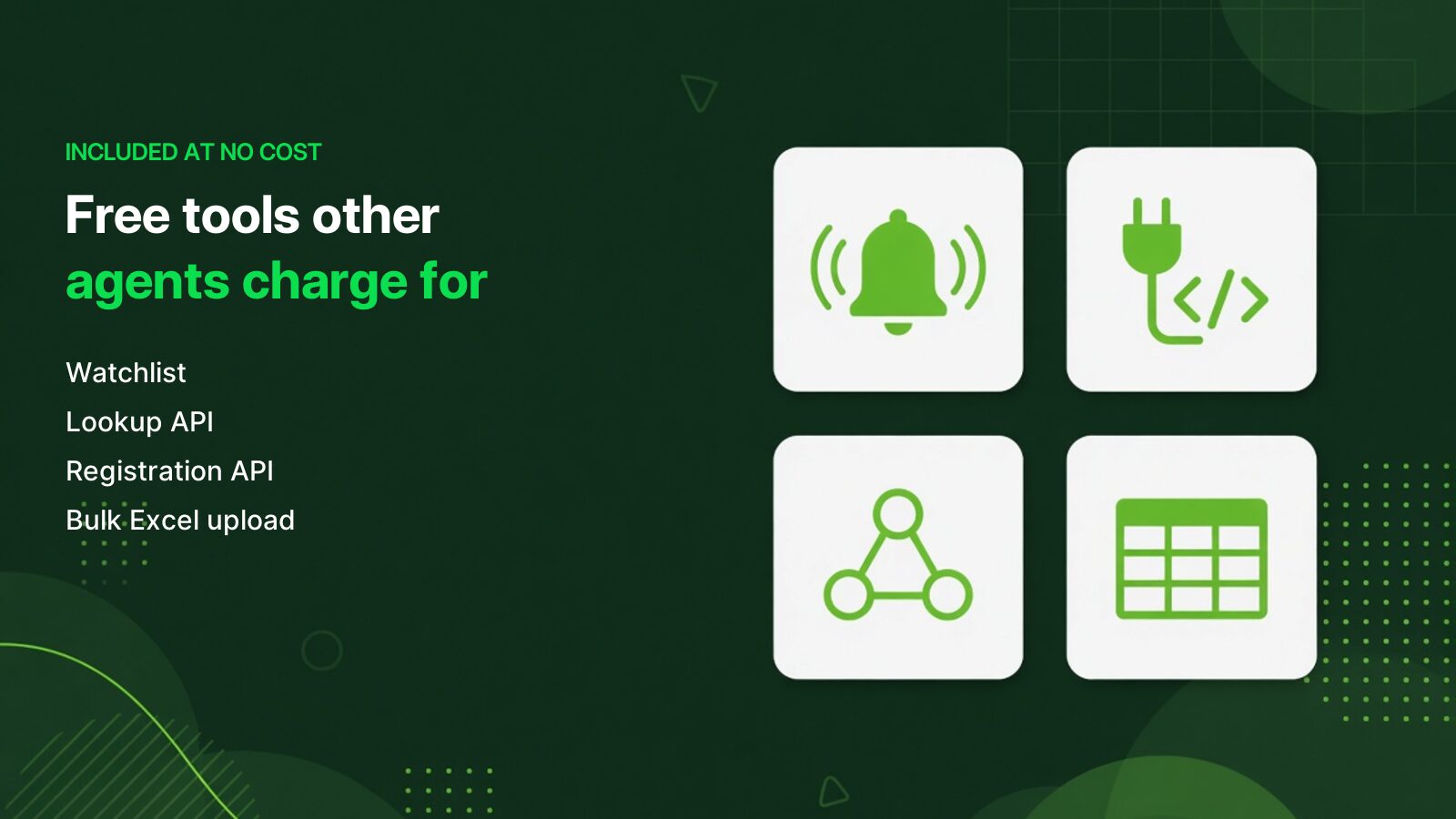
This is the part of LEI Lookup’s offering that tends to get buried, and it shouldn’t. A Watchlist, a Lookup API, a Registration API, and a bulk Excel upload are all included at no cost, in a category where other registration agents commonly charge for these as paid add-ons.
Most agents will sell you the basic registration and then charge a separate fee or place the automation tools behind a higher tier.
The two APIs matter for anyone trying to avoid manual data entry. The Lookup API lets a system pull LEI verification results programmatically, useful for an onboarding flow that needs to check a counterparty’s code the moment a new account is created.
The Registration API goes further, allowing an organization to embed one-click LEI registration directly into its internal tools, rather than sending staff to a separate website each time a new entity needs a code.
Bulk Excel upload serves a different kind of user. Fund administrators, corporate service providers, and banks can register or renew dozens of LEIs in a single upload, rather than working through each one individually or embedding one-click registration into their own systems.
A firm managing a large book of funds or client entities can process a batch of renewals in a single pass rather than opening each record individually.
Issuer coverage behind the scenes
Where an LEI is actually issued from matters less to most users than whether it works, but it affects how quickly a registration or renewal can be processed and how broad the underlying data pool is. LEI Lookup issues through three accredited issuers, Ubisecure RapidLEI, Nasdaq, and WM Datenservice, giving it broader issuer coverage than an agent that routes everything through a single partner.
If one issuer has a backlog or a regional limitation, having alternatives in the background is a practical advantage even if the end user never sees the routing happen.
Where it fits and where it doesn’t
Best for: compliance teams doing counterparty checks before a transaction, onboarding teams verifying new clients, and organizations like fund administrators or corporate service providers managing a high volume of entity codes across multiple jurisdictions. The bulk upload and the Registration API are built specifically with that higher-volume user in mind.
Less ideal for: someone who needs to register a single LEI once and will never think about it again. The free Watchlist and API tools are genuinely valuable, but their payoff increases with the number of entities you track. A one-off registration doesn’t need a dashboard.
A real trade-off worth naming: because LEI Lookup positions itself around ongoing tracking and bulk management, a user who only wants a bare-bones, single-transaction registration may find the interface built around more capability than they need. That’s not a flaw in the service, just a mismatch for a narrow use case.
Another honest limitation is that, like any Registration Agent, the renewal and issuance timeline still depends, in part, on the issuer processing the request, not solely on LEI Lookup’s own systems.
Legitimacy and accreditation
A free LEI Lookup operates as an accredited Registration Agent, a designation that authorizes it to handle LEI issuance and renewal on an entity’s behalf rather than acting as an unaffiliated reseller.
Frequently asked questions
Does checking an LEI on LEI Lookup cost anything?
Searching the global database and pulling up an entity’s record page is part of the free lookup function described on the site.
Who Actually Needs The Watchlist?
Anyone tracking more than a handful of LEIs. A single-entity user might not notice the benefit, but a team responsible for dozens of counterparty codes will find it replaces a repetitive manual check.
What’s the difference between the Lookup API and the Registration API?
The Lookup API pulls verification data into another system. The Registration API allows the same system to initiate a new registration or renewal without redirecting the user to a separate site.
The Verdict on FREE LEI Lookup
LEI Lookup’s strongest case is for the compliance or operations team that’s tired of treating LEI management as a once-a-year scramble. The combination of free Watchlist tracking, both APIs and bulk upload, addresses the actual workflow problem: LEIs don’t expire on a convenient schedule, and nobody wants to check GLEIF’s registry one entity at a time.
Routing registrations through three accredited issuers rather than one also means less exposure to a single point of failure if an issuer gets backed up. For a fund administrator, corporate service provider, or bank handling entity codes at volume, that combination of free tooling and issuer breadth is hard to match against an agent charging separately for the same features.
For a one-time registration, a free LEI Lookup is still a solid option, just one with more capabilities than that user strictly needs.
Disclosure: This Small Biz Tipster blog post may contain affiliate links. I may earn a commission from qualifying purchases at no extra cost to you. Some sections were drafted with AI tools and carefully reviewed/edited by me.

I’m Lisa Sicard, founder of Inspire To Thrive.
Small Biz Tipster is my dedicated space for straightforward, no-nonsense tips that help small business owners grow smarter and faster. Voted in the Top 100 Small Business Blogs by Feedspot for 2025 and 2026, and with over 30 years of hands-on digital marketing experience, I share simple strategies here so you can save time on social media, attract more customers, and focus on what you love — running your business. Through Inspire To Thrive, I also provide social media management, training, and consultations.