A supplier’s unit price can look profitable on a spreadsheet while the finished order quietly loses money. Freight, duties, taxes, inspection fees, and delays often appear after a small business has committed to the purchase, leaving little room to adjust retail pricing.
The solution starts with treating sourcing as a full-cost decision. When every expense is assigned to the products that caused it, you can fairly compare suppliers, set realistic prices, and protect cash flow before placing the next order.
Understanding how to calculate landed cost is essential for making informed sourcing decisions. It allows businesses to accurately assess the profitability of their purchases and avoid unexpected costs.
Table of Contents
What Is The True Landed Cost?
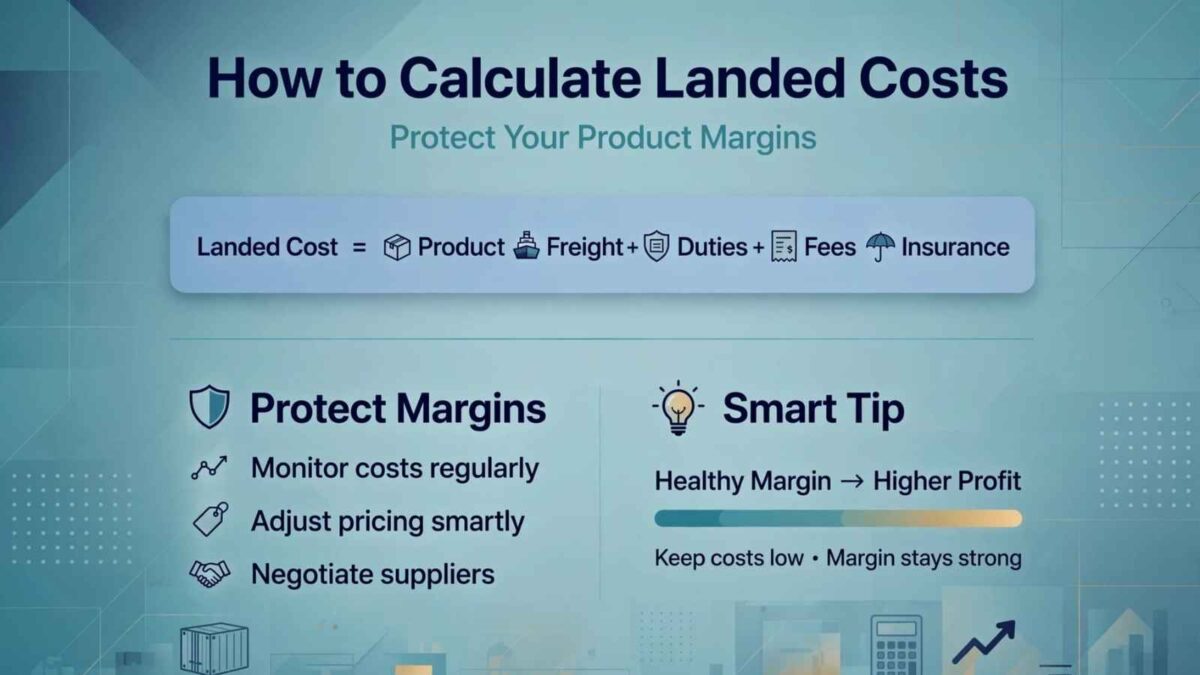
Landed cost is the total amount spent to purchase goods and bring them to the location where they can be sold or used. It includes the supplier’s price plus transportation, duties, taxes, insurance, handling, and other charges tied to the shipment.
This broader view explains why landed costs matter when you calculate product margins and how to calculate landed cost effectively.
Examples of True Landed Cost
Consider a retailer ordering 1,000 reusable bottles at $6 each. The initial product cost is $6,000, but international freight adds $1,100, duties and taxes add $650, insurance costs $100, and local delivery costs another $250.
The true landed cost is $8,100, or $8.10 per bottle. A selling price based on the original $6 figure would overstate the margin by $2.10 per unit.
Build a landed-cost worksheet that separates charges into three groups:
- Product expenses, including unit prices, samples, packaging and quality checks
- Shipment expenses, including freight, insurance, storage and handling
- Import expenses, including duties, taxes, customs processing and classification support
Allocate order-level costs across individual units. If products differ sharply in weight, size or value, a simple unit average may distort the result. Freight can be assigned by weight or volume, while insurance and duties may be allocated by product value.
This calculation also makes supplier comparisons more accurate. A factory offering a lower unit price may require larger orders, more expensive shipping, or extra quality control.
👉 Analysis of these cheap sourcing risks shows why the lowest quote doesn’t always yield the strongest margin.
Where Sourcing Budgets Fall Apart
Many sourcing budgets fail between the supplier quote and the final delivery. Teams record the obvious expenses but overlook smaller charges that accumulate over the course of a shipment.
Banking fees, currency conversion costs, document corrections, port storage, and last-mile delivery can turn a promising order into a cash flow problem.

Timing creates another gap. A supplier may request a deposit months before the products generate revenue. Meanwhile, the business pays for freight, import charges, and warehouse space.
👉 If the shipment arrives late, seasonal products may need to be discounted, reducing revenue even as costs have increased.
How To Calculate Landed Costs – A Checklist
Use a pre-order checklist before approving a purchase. Confirm the delivery terms, payment schedule, expected transit time, and responsibility for each stage of the transportation process.
Ask the supplier which services are included in the quote and get the answer in writing. Discussions of the hidden costs of outsourcing also highlight expenses connected with oversight, communication and supplier management.
Import charges deserve special attention because they can vary by product classification, origin and destination. Before committing funds, enter the shipment details into a Tariff Calculator to estimate duties, taxes and tariffs for eligible goods moving into Canada or the United States from supported origins.
Add a contingency line to the sourcing budget as well. A reserve of 5% to 10% can absorb moderate changes in freight, exchange rates, or handling costs. Treat that reserve as protection for cash flow, not as money available for a larger order.
Using a Tariff Calculator for Precision
Accurate estimates depend on accurate inputs. A calculator can only work with the product description, value, origin, and destination you provide, so avoid broad labels such as “accessories” or “parts.”
Record what the item is made from, what it does, and how it will be sold. These details help identify the appropriate classification.
Start with the commercial value of the goods and the currency used on the invoice. Next, confirm the country of origin, which may differ from the supplier’s office or shipping location.
A distributor in one country might sell products manufactured elsewhere, and that distinction can affect their duty treatment.
Compare Suppliers
Run calculations while comparing suppliers, not after choosing one. Suppose Supplier A charges $9 per unit and Supplier B charges $9.60. If the first option incurs a higher duty rate and costs more to transport, Supplier B could offer a lower landed cost.
This is where true landed cost analysis becomes more useful than a unit-price comparison.
Save each estimate with the supplier quote and date. Rates, shipping charges, and exchange values can change, so an estimate prepared three months ago may no longer support a current purchasing decision.
If a classification seems uncertain or the order represents a large share of your available cash, seek qualified customs guidance before shipment.
How To Calculate Landed Cost with a Calculator
A landed cost calculator provides an estimate, not a guarantee of the final invoice. A cost landed formula gives you a much stronger basis for pricing, supplier negotiations, and order planning.
It can also expose a weak margin early enough to prompt changes to the order quantity, product mix, or source.
Keeping Margins Healthy Over Time
Landed cost should be monitored after every shipment because supplier pricing is only one moving part. Freight rates, exchange rates, duties, and warehouse charges can change without affecting the purchase price. If your records still use figures from an older order, current sales may appear more profitable than they are.
Create a simple cost review for each shipment. Compare the original estimate with the final amount paid, then record the difference by category. A repeated gap in one area points to a planning issue.
For example, consistent storage charges may indicate that documents are arriving late, while frequent delivery surcharges may suggest that the chosen freight arrangement excludes the final leg.
Update Product Margins
Update product margins using the actual landed cost. A practical unit economics record should include landed cost per unit, selling price, marketplace or payment fees, fulfillment cost, and expected returns. This reveals the contribution margin left to cover rent, payroll, marketing, and other overhead.
Review pricing when the margin falls below a preset threshold. Your response might involve raising the selling price, negotiating a lower minimum order, consolidating shipments, or replacing a product that no longer earns enough. The right option depends on customer demand and how much cash the inventory ties up.
Cost Controls
Cost control should extend beyond sourcing. These cost-effectiveness strategies can help you examine recurring business expenses without relying on across-the-board cuts that may hurt service.
Keep a short history of estimates and final costs for each supplier. After several orders, that record will show which quotes are dependable and which vendors regularly create extra expenses.
The next purchase order can then be based on documented performance, with a landed-cost figure that reflects what the business is likely to pay.
Disclosure: This Small Biz Tipster blog post may contain affiliate links. I may earn a commission from qualifying purchases at no extra cost to you. Some sections were drafted with AI tools and carefully reviewed/edited by me.

I’m Lisa Sicard, founder of Inspire To Thrive.
Small Biz Tipster is my dedicated space for straightforward, no-nonsense tips that help small business owners grow smarter and faster. Voted in the Top 100 Small Business Blogs by Feedspot for 2025 and 2026, and with over 30 years of hands-on digital marketing experience, I share simple strategies here so you can save time on social media, attract more customers, and focus on what you love — running your business. Through Inspire To Thrive, I also provide social media management, training, and consultations.