
Most small business owners read their reviews the same way. A new one comes in, you check the star rating, feel good or feel annoyed, and move on with your day. However, understanding customer feedback is crucial; it provides valuable insights into customer sentiments that can be used as Customer Reviews as Free Market Research.
That’s a shame, because your reviews are one of the most honest sources of customer research you’ll ever get. Nobody filled them out because you paid for a survey. People wrote them because something about working with you stuck with them, good or bad, and they wanted to say so in their own words.
If you read them as a set rather than one at a time, they’ll tell you what customers value, what bugs them, and how they describe you to others. Here’s how to pull that out without spending a fortune or hiring anyone.
Table of Contents
Why Customer Reviews as Free Market Research Beat Most Surveys
By leveraging Customer Reviews as Free Market Research, you can gain insights that surveys simply can’t provide. Surveys have their place, but they come with a built-in problem.
You write the questions, so you only hear about the things you already thought to ask. Customers also tend to answer surveys politely and quickly, which doesn’t tell you much.
Reviews are different, as the customer picks the topic:
- If they mention how fast you returned their call, that’s because it mattered to them.
- If three people in a row mention parking, that’s something you probably wouldn’t have put on a survey at all.
- They’re also free and keep coming in on their own, as long as you’re asking. If you’re not asking yet, start there.
Small Biz Tipster has a helpful guide on how to ask for reviews without it feeling awkward.
👉 The more reviews you collect, the clearer the patterns get.
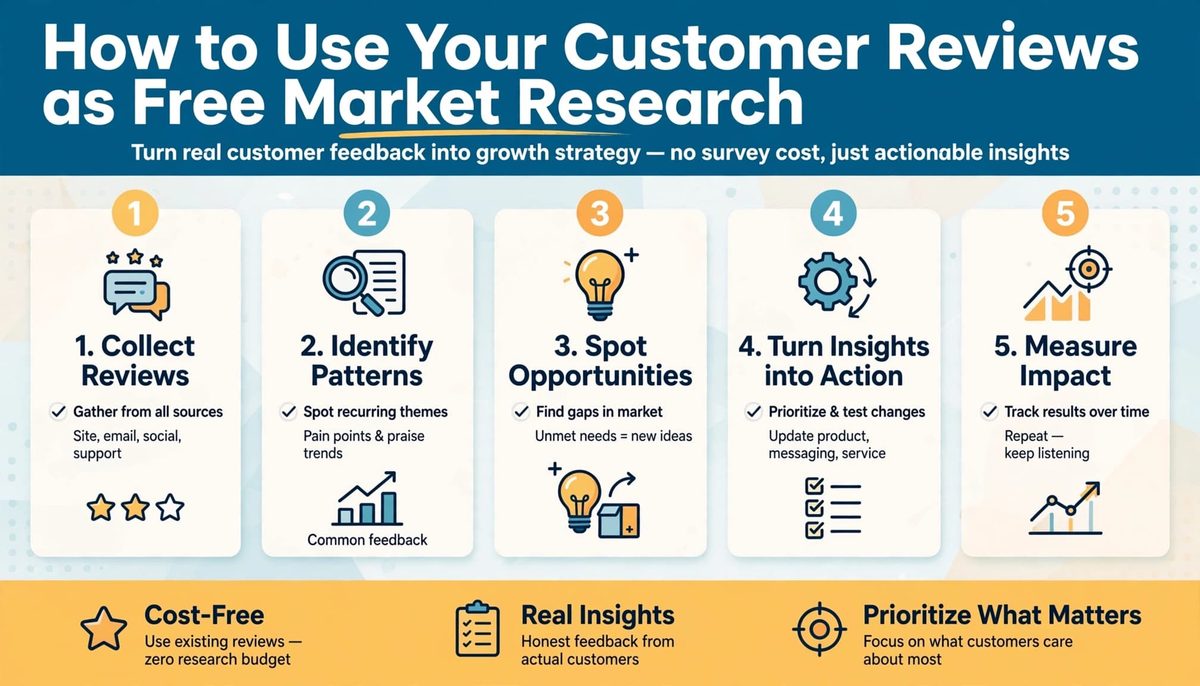
Gather Everything in One Place
You can’t spot patterns if your reviews are spread across Google, Facebook, Yelp, and an industry site you check twice a year. The first job is getting them side by side.
For most small businesses, a simple spreadsheet is enough. Copy in the last 50 to 100 reviews with the date, the platform, the star rating, and the full text. It takes an afternoon the first time, and after that it’s a few minutes a week to add the new ones.
If you’d rather not do it by hand, review software can help with the collecting side. A platform like Review Monster sends review requests automatically after each job, so the steady flow of fresh feedback you need for this kind of reading keeps coming without anyone on your team having to remember.
Read for Patterns, Not Stars
The star rating tells you how someone felt. The text tells you why. That second part is where the useful information lives.
Go through your collection and tag each review with the topics it mentions. Keep the tags simple and add new ones as you go. Most businesses end up with something like this:
- Speed (response time, wait time, turnaround)
- Staff (friendliness, knowledge, a specific person by name)
- Price and value
- Quality of the product or the finished work
- Communication (updates, reminders, clear quotes)
- Convenience (location, booking, hours, payment)
Once everything is tagged, count them up. You’ll often find that one or two topics show up far more than you’d expect.
👉 That’s your answer to the question “what do people actually come to us for?”
Pay Attention to the Middle
Five-star reviews tell you what’s working. One-star reviews are often about a single bad day. The three- and four-star reviews are where the gold usually is, because they come from customers who liked you overall but noticed something that held you back from full marks.
Phrases like “great work, but” or “would have been five stars if” are worth writing down every time. Those customers are telling you exactly what to fix, and they’re still on your side.
Borrow the Words Your Customers Use in Reviews
Here’s a part a lot of owners miss. Reviews show you how real people describe what you do, and that language is often better than anything you’d come up with in a marketing meeting.
Maybe you call it “comprehensive maintenance plans,” and your customers call it “they just take care of it so I don’t have to think about it.” Guess which one a new customer relates to?
Keep a running list of phrases that come up again and again, then use them on your website, in your ads, and in the way your team explains your services on the phone.
You can also turn standout reviews into content, as Small Biz Tipster suggests in its post on using trending custom reviews to boost a small business. Just ask the customer first if you plan to quote them by name.
Turn What You Find Into Small Fixes
Research is only worth doing if something changes because of it. The good news is that review feedback usually points to small, practical fixes rather than big overhauls.
A few examples of what that can look like:
- Several reviews mention not knowing when the crew would arrive, so you start sending a text the morning of the job.
- Customers keep praising one employee by name, so you ask that person to help train new hires.
- People mention being surprised by the final price, so you add a line to every quote explaining what could change it.
- Reviews keep saying the waiting area is cramped, so you move appointments slightly further apart.
Pick one or two changes at a time. If you try to fix everything at once, it’s hard to tell what made the difference.
Close the Loop With Your Customer Reviews as Free Market Research
When you make a change because of feedback, say so. Replying to reviews is a good place to do it. A short, specific reply like “thanks for mentioning the wait, we’ve added a second person at the front desk on Saturdays” shows future customers that you listen.
Google has its own tips on replying to reviews that are worth a quick read. Keep replies short, thank people by name where it makes sense, and take any real problems offline.
One word of caution. Treat reviews as research, not something to manage or tidy up. Don’t offer discounts for good ones, write fake ones, or pressure people to change what they said.
The FTC’s rule on consumer reviews and testimonials spells out what’s off-limits, and an honest set of reviews is more useful to you anyway. A profile with nothing but glowing comments doesn’t teach you anything.
Make It a Monthly Habit
None of this needs to be a big project. Set aside half an hour once a month to add the new reviews to your sheet, tag them, and look at what’s changed.
Ask yourself three simple questions each time:
- What are people praising more than last month?
- What complaint or “but” keeps coming back?
- Is there a phrase customers use that we should be using too?
Over a few months, you’ll have a clear picture of where your business is getting stronger and where it’s slipping, long before it shows up in your sales numbers.
Conclusion: How To Use Customer Reviews as Market Research
Your customer reviews are already working for you by bringing in new customers. They can do a second job, too, if you take the time to read them as a whole rather than one by one.
Gather them in one place, tag the topics, pay close attention to the middle ratings, and borrow the words your customers use.
Then make one small change and tell people you made it. It’s the cheapest market research a small business will ever get, and it’s sitting right there on your profile.
Disclosure: This Small Biz Tipster blog post may contain affiliate links. I may earn a commission from qualifying purchases at no extra cost to you. Some sections were drafted with AI tools and carefully reviewed/edited by me.

I’m Lisa Sicard, founder of Inspire To Thrive.
Small Biz Tipster is my dedicated space for straightforward, no-nonsense tips that help small business owners grow smarter and faster. Voted in the Top 100 Small Business Blogs by Feedspot for 2025 and 2026, and with over 30 years of hands-on digital marketing experience, I share simple strategies here so you can save time on social media, attract more customers, and focus on what you love — running your business. Through Inspire To Thrive, I also provide social media management, training, and consultations.