
Understanding how Solopreneurs Evaluate Established Ventures is essential for making informed decisions.
An established venture gives a solopreneur something a new startup cannot: evidence. Sales records, customer behavior, and operating expenses reveal how the business performs before you commit your time and capital.
Still, past revenue alone doesn’t make an acquisition worthwhile.
You need to test the quality of the earnings, confirm that the operation aligns with your skills, and understand what will be required after the ownership change. A disciplined review helps separate a manageable opportunity from a business that depends heavily on its current owner.
Table of Contents
Analyzing Existing Revenue Streams
Start by mapping every revenue source and calculating its share of total sales. Common startup revenue models include:
- Subscriptions.
- Service fees.
- Product sales.
- Advertising.
Each produces different levels of predictability.
Review at least two years of monthly financial statements, bank deposits and processor reports. Look for seasonality, declining order values and unusual sales spikes.
A business earning $12,000 each month from 300 repeat customers may be more dependable than one earning $20,000 from two short-term contracts.
Also measure customer concentration. If one account supplies 40% of annual revenue, ask what will keep that client after the transfer.
Confirm renewal terms, cancellation rates and gross margins for each revenue stream.
Defining the Best Business to Buy
Your acquisition criteria should reflect your budget, experience and available working hours. General guidance on selecting a suitable business idea can help you identify industries that match your interests and abilities. Acquisition research then adds deal-specific factors such as price, cash flow and transferability.
When comparing the best business to buy, examine platforms based on deal size, business type and access to financial details. Set firm limits before reviewing listings. For example, you might seek an online service business priced below $300,000 that produces at least $90,000 in annual owner earnings.
Write down your nonnegotiable criteria. These may include recurring revenue, no single customer accounting for more than 15% of sales, and documented procedures for core tasks.
👉 Clear limits reduce the risk of chasing an attractive listing that doesn’t fit your goals.
How Solopreneurs Evaluate Established Ventures by Evaluating Daily Operational Demands
Ask the seller for a detailed account of a normal week. The answer should cover customer service, sales, fulfillment, bookkeeping, and vendor management. Then compare the claimed workload with supporting evidence.
A seller who reports a 15-hour workweek but personally handles 80 customer messages each day may be underestimating the commitment.
Identify duties that require the owner’s personal relationships or specialized knowledge. If suppliers negotiate only with the seller, or if customers expect direct access to that person, revenue could weaken after the handoff.
Estimate your own workload for the first 90 days. Include training, staff meetings, and system access changes alongside normal operations. Price any outside help you’ll need.
👉 A bookkeeper costing $600 per month or a contractor costing $2,000 can materially change the earnings available to you.
How Solopreneurs Evaluate Established Ventures by Brand and Reputation
Solopreneurs should assess an established venture’s brand by checking whether its reputation matches the customer experience: read recent reviews, note how owners respond to complaints, and look for consistent messaging across its website and public profiles.
Then compare that trust with the business’s financial records and customer relationships, since a recognizable name won’t offset weak operations or unresolved issues.
Growth Potential
Solopreneurs evaluate an established venture’s growth potential by checking whether demand is strong enough to support expansion. They review:
- Sales trends.
- Customer feedback.
- Margins.
- Cash flow.
- Competition to see where the business can grow without stretching its resources too far.
For example, adding a service for existing customers may offer a lower-risk path than entering a new market or launching an unrelated product. They also assess whether current systems, staffing, and finances can handle more work, since growth can strain operations and reduce service quality.
I’ve been doing this for a new product that is unrelated to my own business, launching a crocheted scrubby product line. I had to research how many to sell to make shipping worthwhile; the answer was a package of 10.
👉 A sound opportunity has clear customer demand, realistic costs, and a practical plan for funding and managing expansion.
How Solopreneurs Evaluate Established Ventures by Structuring Prudent Transfer Terms
Before buying an established venture, review its financial records, contracts, debts, and tax obligations, and then specify in the purchase agreement which liabilities transfer and which remain with the seller.
Build in clear payment, indemnity, and handover terms, and use a business-buying due diligence checklist to catch risks before closing.
Here is how to structure transfer terms:
- Tie the purchase terms to risks found during your review.
- If customer retention is uncertain, part of the price could depend on revenue remaining above an agreed level for six months.
- Seller financing can also keep the former owner invested in an orderly transition, though repayment terms must fit conservative cash flow projections.
- Document what the sale includes, such as equipment, customer records, digital accounts, supplier agreements and intellectual property.
- Specify the training period and the seller’s availability after closing.
- Even a straightforward business may need 30 days of scheduled training followed by limited support.
- Use qualified legal and financial professionals to review the final agreement, tax treatment and funding structure.
- Before signing, test the business against a downside case with revenue 20% below expectations.
- If payments and essential expenses still fit, the terms offer a more practical margin for error.
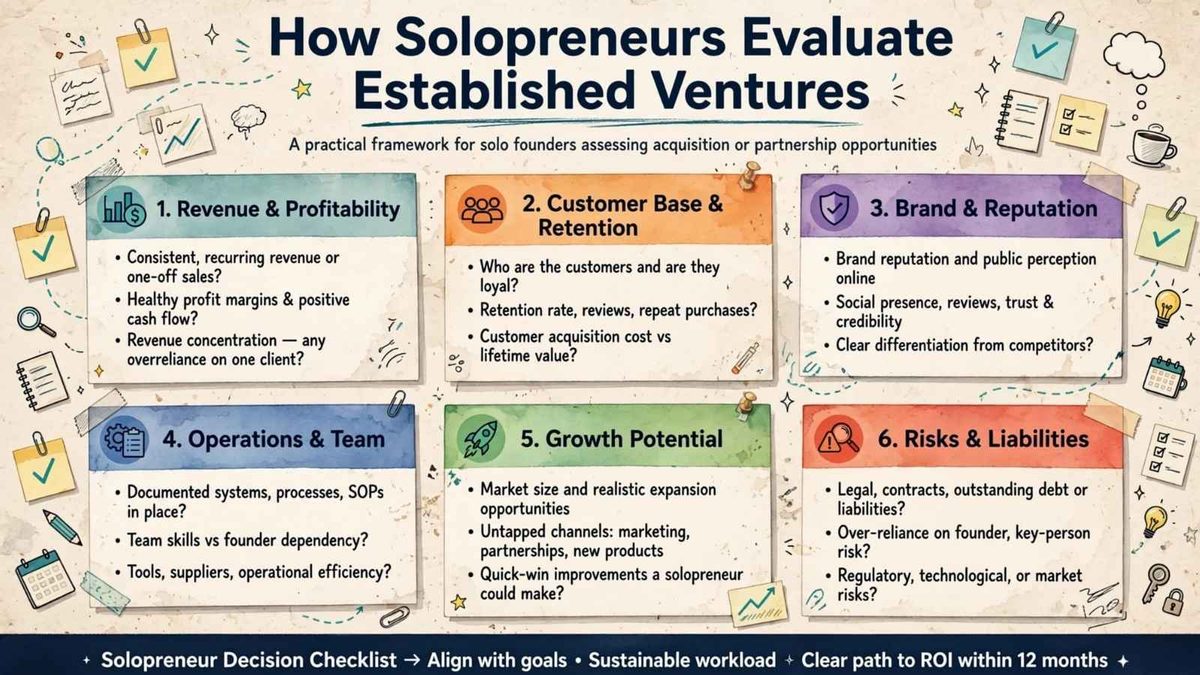
Conclusion: How Solopreneurs Evaluate Established Ventures
A sound acquisition should remain viable after the seller steps away and a slower sales month sets in. Build your final offer from verified cash flow, realistic labor requirements, and clearly assigned transfer duties.
👉 Those details will shape your first months as an owner far more than the listing headline.
Disclosure: This Small Biz Tipster blog post may contain affiliate links. I may earn a commission from qualifying purchases at no extra cost to you. Some sections were drafted with AI tools and carefully reviewed/edited by me.

I’m Lisa Sicard, founder of Inspire To Thrive.
Small Biz Tipster is my dedicated space for straightforward, no-nonsense tips that help small business owners grow smarter and faster. Voted in the Top 100 Small Business Blogs by Feedspot for 2025 and 2026, and with over 30 years of hands-on digital marketing experience, I share simple strategies here so you can save time on social media, attract more customers, and focus on what you love — running your business. Through Inspire To Thrive, I also provide social media management, training, and consultations.