
A weak mission statement is rarely a writing problem. It’s usually a business clarity problem. If your mission reads like every other company page, or you have no mission statement at all, you’re not behind.
You’re normal. Most small business owners are busy selling, solving problems, and putting out fires. A strong mission statement, foundational to your business strategy, gets pushed to “later,” then stays there.
That matters more than it seems. When your mission is clear and aligned with your company’s vision, you make faster decisions, attract better-fit customers, and keep your team pointed in the same direction. Start there.
Table of Contents
Key Takeaways: Why a Weak or Missing Mission Statement Hurts Your Business
- Weak mission statements stem from issues with business clarity, not writing skills. Small business owners prioritize daily fires over strategic direction.
- A strong mission acts as a decision filter for offers and partnerships, builds customer trust by addressing real needs, and aligns team efforts for consistency.
- Fix yours by starting with who you help and the problem you solve, using plain language over buzzwords, rigorously testing it, and ensuring it matches how you actually run the business.
- Update outdated missions to reflect evolved offers and audience insights; treat it as a practical tool, not a trophy.
Why do so many small businesses end up with a weak mission statement?
Most small businesses don’t ignore mission statements because they don’t care. They ignore them because the work feels urgent somewhere else.

When you’re answering emails, chasing invoices, and fixing customer issues, writing a mission statement can feel like fluff. So you skip it. Or you write one in ten rushed minutes and move on.
That’s how a business ends up with no mission statement, or one that makes Meaningless Promises. It lives on an About page and never helps you make a real decision.
You’re too overwhelmed to focus on Strategic Direction or pursuing Long-term Goals.
You are trying to sound impressive instead of being clear
A lot of mission statements collapse under fancy language. “Empowering excellence through innovative solutions” sounds polished. It also sounds like 500 other businesses.
Your customers don’t need polished. They need clarity. What do you do, who do you help, and why should they trust you? If your statement dodges those basics, it won’t stick.
You built it once, then never looked at it again
Maybe you wrote a mission during startup mode. Since then, your offers have changed. Your audience shifted. Your best customers taught you what they care about.
- But the old statement stayed put, causing a loss of Brand Identity.
- A mission statement isn’t a trophy. It’s a tool.
- If it no longer fits how you run the business, it needs an update, not nostalgia.
What a strong mission statement actually does for your business
A strong mission statement isn’t there to impress investors or fill blank space on your site. It’s there to make your business easier to run.

This is where your mission statement starts paying rent.
If an offer, partnership, product idea, or marketing channel doesn’t fit your purpose, you can stop forcing it. Your mission gives you a clear filter for business decisions.
Think about the bad opportunities that look exciting on paper:
- A client who wants to work outside your wheelhouse.
- A partnership that brings attention, but not the right buyers.
- A new offer that makes money but drags you away from your core service.
Your mission helps you say “no” confidently and direct your time and money toward what truly aligns.
It gives customers a quick reason to trust you
Customers compare you fast. If your message is vague, they fill in the blanks themselves. Usually, that doesn’t help you.
A strong mission tells them what you care about and who you help, directly addressing customer needs. It makes your business feel human, not generic. That creates a competitive advantage when your market is crowded, and competitors offer similar prices or services.
It keeps your team and your content on the same page
Without a shared mission, every touchpoint starts to drift. Your website says one thing. Your social posts say another. Your team handles customers in three different styles.
A clear mission creates consistency. It guides how you write, how you sell, and how you solve problems. Even if your team is small, that alignment improves internal culture and drives employee engagement, saving time.
How to fix a weak mission statement and make it useful
You do not need a branding workshop. You need a mission statement you can use on Monday morning.

Begin with the customer, not your company.
Ask three simple questions. Who do you help? What problem do you solve? What result do you help create?
If you run a bookkeeping business, “We help local service businesses keep clean books and clear cash flow” is already more useful than a paragraph of brand fluff. It gives you a real starting point.
Use plain language, not brand fluff
Short beats fancy. Clear beats clever. Storytelling makes plain language more engaging without adding fluff.
This quick comparison shows the difference:
| Weak mission statement | Stronger mission statement |
|---|---|
| We deliver innovative excellence for every client. | We help busy small-business owners simplify their marketing so they can win more local customers. |
| We are committed to quality and growth. | We build websites for service businesses that need more calls, not more confusion. |
| We empower transformation through strategy. | We help coaches turn their expertise into clear offers people understand and buy. |
If a customer can’t understand your mission in one read, rewrite it.
Check it against these 10 simple tests before you keep it
Use the mission statement tool to draft or tighten your wording, then test it out loud.
Ask yourself:
- Is it clear on the first read?
- Does it say who you help?
- Does it name a real problem your customers have?
- Does it hint at the positive outcome or result?
- Does it sound like your business, not everyone else’s?
- Could a customer understand it in under 10 seconds?
- Is it free of buzzwords and corporate fluff?
- Can your team actually use it in daily decisions?
- Is it believable and authentic to how you run the business?
- Would you still stand behind it six months from now?
Quick rule: If you answer “no” to more than three of these, rewrite it.
Make sure it fits how you actually run the business
Your mission should match your real choices. If you say you value simplicity, but your process is a maze, you are lying. Customers feel that. Executive leadership must embody the mission for it to work.
You can also shape your wording by niche. A few simple templates:
- Coaches: “You help [audience] move from [problem] to [result] with [method].”
- Consultants: “You help [type of business] fix [specific issue] so they can [business outcome].”
- E-commerce brands: “You create [type of product] for [customer] who want [benefit].”
- Service businesses: “You help [local or niche audience] solve [problem] with dependable [service].”
Use the template as a draft, not a script. Then pressure-test it against how you sell, serve, and grow. A clear mission influences the organizational structure, helps attract top talent, and improves productivity by clarifying roles.
A sample Mission Statement
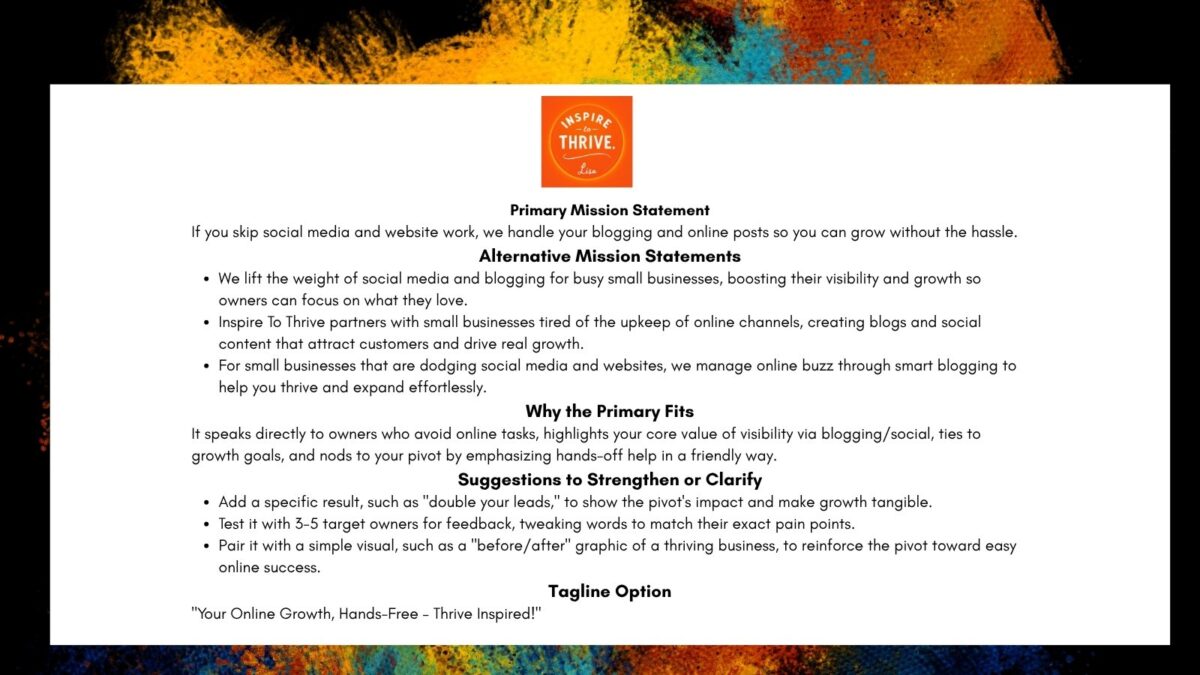
Of course, I had to make a mission statement for my main business, Inspire To Thrive. Here’s the primary mission statement I created for Inspire To Thrive using the process above:
Frequently Asked Questions About No Mission Statement and Why You Need One
Why do most small businesses lack a strong mission statement?
Small business owners get consumed by urgent tasks like emails, invoices, and customer fixes, pushing mission work aside as fluff. They might rush a generic one or reuse an outdated startup version that no longer fits. The result is vague statements that gather dust without guiding real decisions.
What does a strong mission statement actually achieve?
It filters out misaligned opportunities, helping you say no to distracting partnerships or offers. Customers quickly grasp who you help and why they should trust you, helping you stand out in crowded markets. It also keeps your team, content, and sales messaging consistent for better alignment and efficiency.
How do you write a useful mission statement from scratch?
Start with three questions: Who do you help? What problem do you solve? What result do you create? Use plain, customer-focused language like ‘We help busy small business owners simplify marketing to win local customers,’ avoiding buzzword fluff. Templates for niches like coaches or service businesses provide a solid draft.
How can you test if your mission statement works?
Run it through a 10-question checklist: Is it clear on first read? Does it name who you help, a real problem, and the outcome? Free of buzzwords and believable for daily use? If more than three ‘no’ answers, rewrite it. Tools like the mission statement tool can help refine wording.
Does a mission statement need to change over time?
Yes, if your offers, audience, or business focus shift, the old one loses relevance and erodes brand identity. Review it periodically against how you sell and serve today. A living mission embodies your real choices, boosting decisions, team motivation, and customer loyalty.
Conclusion: Consequences of Not Having a Mission Statement
If you have a weak mission statement or no mission statement, you’re in crowded company. The fix is not complicated. You need clarity, not cleverness.
A strong mission statement, transformed into a Mission-based Story, improves team dynamics, boosts customer loyalty, enhances corporate governance for small businesses, drives employee motivation through consistency, and builds stronger relationships with business partners.
Review what you have now. If it feels vague, rewrite it and run it through the mission statement tool. A few clear words can save you from a lot of messy decisions later.
Disclosure: This Small Biz Tipster blog post may contain affiliate links. I may earn a commission from qualifying purchases at no extra cost to you. Some sections were drafted with AI tools and carefully reviewed/edited by me.

I’m Lisa Sicard, founder of Inspire To Thrive.
Small Biz Tipster is my dedicated space for straightforward, no-nonsense tips that help small business owners grow smarter and faster. Voted in the Top 100 Small Business Blogs by Feedspot for 2025 and 2026, and with over 30 years of hands-on digital marketing experience, I share simple strategies here so you can save time on social media, attract more customers, and focus on what you love — running your business. Through Inspire To Thrive, I also provide social media management, training, and consultations.